A more personal read on the places I've worked, the good ones, the rough ones, and the several that didn't outlast me. Honest, I hope, without being unkind.
Freelancing is where I started: a run of bedroom-coded C64 games in the late '80s. Here are the ones worth telling.
Flying Shark · 1987
I answered a small ad for games programmers in the local paper and landed at Catalyst Coders, a ragtag collection of young coders eager for a first break, working out of a couple of grubby rooms above a shop in Neath. They handed me Taito's arcade game Flying Shark to convert to the C64, on my own, with one part-time graphics guy and three months to do it.
Bob Pape was in the same building writing R-Type for the Spectrum, he's since written an excellent book about it. We shared the place with a taxi firm whose radio our equipment kept interfering with, so we weren't popular. After a fortnight I decided, with what passed for confidence at the time, to work from home instead. Less chance of being eaten by rats.
We had no arcade machine for reference, just a wobbly video we'd secretly filmed in a nearby arcade. Full-colour scrolling in three directions, far more moving objects than the C64's official eight sprites, and dense level graphics, all to be worked out from first principles, because there was no Google to ask. I got it done. It was far too hard to actually play, since there was no time left to tune it, not my proudest moment, but it reviewed well.
For the record: Dom Robinson and John Cumming wrote the Spectrum version and were the names on the C64 cassette box, and therefore in the reviews. But I'm not bitter.
Maze Mania · 1989
After the near-death experience of Flying Shark, Hewson Consultants asked me to write a maze-chase game for the princely sum of £1,000. I came up with a simple concept, reused my scrolling code from the Shark, and had it done in a couple of months, far less painful than its predecessor.
The moment I handed over the master, Hewson Consultants promptly went bankrupt and the release was scrapped. I licked my wounds and moved on, only to find that Andrew Hewson had resurfaced with a new company, 21st Century Entertainment, and released the game anyway, without my knowledge.
//
He still owes me that £1,000. My first proper encounter with the dark side of the games industry.
MicroProse / Hasbro
Software / Sound Engineer · founded the Audio Department
1989-2000 · Tetbury & Chipping Sodbury
Amiga / STAssemblerAudioUnreal
Pete Moreland, the legend, had been at Firebird when I wrote Flying Shark for them, and once he moved to MicroProse he offered me a job as a programmer. I jumped at the chance. The UK office started out making Amiga and ST versions of the American office's PC flight sims, so my first task was rasterisation routines for F-19 Stealth Fighter and F-15 Strike Eagle. I was soon handed a game of my own.
Knights of the Sky · 1990
A jump straight into the deep end. I was teamed with Kevin Buckner to convert the PC version to the Amiga and ST, with two immediate problems: neither of us knew the first thing about 3D programming, and while the PC version was written in C, we were both assembler programmers. Some very long hours went into appearing remotely knowledgeable. We got there in the end, and the game was well received, review scores averaging 92%.
Along the way I wrote the music and made the sound effects myself, because there was no audio department at the time. Which is how I ended up being asked to create and run the all-new MicroProse Audio Department.
Knights of the Sky · the Amiga/ST conversion, music and SFX and all
//
So began ten years of bleeps, bangs and audio drivers.
An audio interlude
First job was to find a composer, since I can play music but I'm a rotten writer of it. We were extraordinarily lucky to get John Broomhall. He knew nothing about game audio when he arrived, his background was radio-commercial jingles, but he went on to write some of the most famous and memorable game soundtracks ever, and it was a privilege to work with him.
I built him a synthesizer interface so he could compose in Cubase on an Atari ST while driving the various sound cards on a connected PC, then compressed the MIDI down to the smallest size the game could bear. To their credit, MicroProse pulled out all the stops: separate music and sound-effect studios, and a voice booth that was mostly used to store empty cardboard boxes.
The production line
We worked on a great many games, it was like a production line, and the pace occasionally showed in the quality. Far too many to list, but here's a taster.
David Leadbetter's Greens. Our first third-party collaboration, and the first time I got the PC speaker to play audio samples. Only a scratchy golf swing, but it was a start.
David Leadbetter's Greens · the first PC-speaker audio samples
Civilisation (Amiga & ST). Such a hit on PC that a conversion was inevitable. Laurie Sinnett somehow crammed all the C code in, and John and I tackled the rather avant-garde music, not easy in four channels with no memory to play with. In the end I took the easy way out and used a tracker, OctaMED. Some of the tracks can make your ears bleed.
Civilisation (Amiga & ST)
The Legacy: Realm of Terror. Another third-party job, and more sample experiments, this time with a real SoundBlaster to play with.
The Legacy: Realm of Terror · sample experiments with a real SoundBlaster
B-17 Flying Fortress. One of the first PC flight sims I worked on. Getting a realistic engine note out of the Roland MT-32, essentially a synthesizer on a card, was very hard going. The music, at least, was good and jaunty.
B-17 Flying Fortress · wrangling an engine note out of the Roland MT-32
Geoff Crammond's Grand Prix · ×3
The Grand Prix games basically kept MicroProse afloat. They sold by the bucketload, and were part of the reason I eventually left. The UK office was fast becoming the "Grand Prix" studio: a high-security suite was built inside the building to house the elite GP coders, security locks and all, very MI5, while other games fell by the wayside.
Still, it was good to be part of while it lasted. I worked on three of them, spent some fantastic days at Silverstone recording effects, and went slightly mad listening to F1 cars for hours, or trying to make an OPL3 chip sound like one. Geoff was a bit of a genius, technically and financially.
Geoff Crammond's Grand Prix · Silverstone effects and an OPL3 pretending to be an F1 car
X-COM: UFO Defense · 1994
A true classic that very nearly wasn't. When development started, nobody thought it would be any good, head office actually cancelled it halfway through and neglected to tell the developers, so it was quietly finished without their knowledge. Just as well: it's now reckoned one of the greatest PC games ever made.
It still haunts me. I've been interviewed for books, magazines and even a GDC lecture on it. It's a sobering thing to see your own face projected twenty feet high to an auditorium of thousands.
X-COM: UFO Defense · the classic that nearly got cancelled
X-COM: Terror from the Deep
Buoyed by the success of UFO Defense, the bosses wanted a sequel, so Terror From The Deep was made in-house at speed, essentially a re-skin with extra story tacked on and a great many bubble sounds. It was another huge success. For the opening movies I somehow lacked the right kit and had to build a Heath Robinson rig: Cubase on an Atari ST, an MT-32 card, a piece of software I wrote to reroute the MIDI, a Gravis Ultrasound loaded with samples, and a Sony Betacam feeding timecode back to the Atari. A miracle we got anything done.
For the record: the screaming as the ship goes down was lifted straight off the telly, from the classic Titanic film A Night To Remember.
X-COM: Terror from the Deep · bubbles, and the Heath Robinson audio rig
Transport Tycoon & Deluxe
Considered one of John's very best, so good we put a jukebox in the game, and fans still try to unravel my compression to extract the music. They won't manage it; it isn't real MIDI. It's unbelievable that Chris Sawyer wrote the whole thing alone, in 100% assembler. I felt faintly embarrassed dropping my audio code into it.
Transport Tycoon Deluxe · the jukebox and that not-quite-MIDI music
Boulder Dash, Balderdash, and X-COM: Alliance
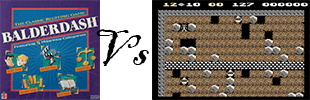
After Transport Tycoon I took a break from audio, my ears hurt. By now Hasbro had taken over and the company's direction had gone a little strange. I'd always loved Boulder Dash, Hasbro apparently held the rights, and they wanted a 3D version, so with a couple of artists and a 3dfx Voodoo card I wrote a 3D engine and built what I thought was a rather good version, classic side-on action plus full-3D interludes above ground. It then emerged that Hasbro held the rights to the board game Balderdash, not Boulder Dash. Either an accent problem or an earwax one; either way, six months' work down the drain.
After that I joined X-COM: Alliance, a first-person shooter where you controlled a squad of four in an alien setting, running on a very early build of the new-fangled Unreal Engine, which would have been lovely if it didn't change from day to day, sometimes needing significant rewrites.
I added four-player simultaneous views, bolted on a front-end, and wrote an audio engine with interactive music. We went all-out: gory, scary, and with actual swearing in the dialogue, mostly a nice American lady from HR yelling "shit" into a microphone with varying inflections.
It was coming along nicely when the powers-that-be moved development to the US office, and it was never heard of again. That's when I knew my time at MicroProse was ending. I'd survived several redundancy sweeps; better to leave on my own terms. Time to move on to pastures new.
X-COM: Alliance · the shooter that vanished into the US office
Odds and ends from the MicroProse years, not a game, but a Gerry Anderson animation demo the art team knocked out in about a week around 1995, using the same cable-everywhere rig and, in all likelihood, a serious fire hazard. (There were also a fair few trips to the US office in Hunt Valley, Maryland, ostensibly to work, mostly to sightsee around Baltimore.)
Gerry Anderson animation demo · ~1995
'Wild' Bill Stealey's tour of the US office · 1990s
A day in the MicroProse UK office, Tetbury · 1991
Software Creations
Lead Programmer
2000-2002 · Manchester
XboxC++Team lead
Once I'd torn myself away from MicroProse, I moved up to Manchester and joined Software Creations as Lead Programmer. Paul Hibbard and Steve Perry, both former MicroProse staff, were there too, so I wasn't entirely alone. The office was on Cheetham Hill Road in North Manchester, an area with a colourful reputation and its share of ladies of the night, so it was a bit of a culture shock on the whole. I led the following two games here.
Nicktoons Racing
A 3D racing game based on the Nicktoons characters. Memories are a little vague on this one (I blame the Manchester nightlife), but I was heading a team of three programmers and a whole gaggle of artists. Development was greatly hampered by Hasbro (them again) insisting on a non-3D-accelerated version. What a nightmare.
My only really clear memory is working until 2am trying to create a Windows installer for it. Still, it got generally good reviews, and let's face it, that's all that really matters.
Nicktoons Racing · lead programmer, and one very late-night Windows installer
2002 FIFA World Cup
I often regard this as the worst six months of my life. I am not a great sportsman, at school I spent all my time running away from the ball, and took up the cello to get out of games, though it was a sport in itself trying to get that thing home on the bus. So asking me to work on a football game was never going to end well, and I had, until now, wiped the whole experience from my mind.
The Xbox was pretty new at this point, it still hadn't been released. All we had to develop on was a prototype Xbox board inside a PC case. When we eventually tried it on an actual Xbox development box and it worked first time, there was much celebration (obviously dampened by the football aspect). Still, it got released, got pretty good reviews, and I never had to look at it ever again.
Suddenly it was all over. One day we were writing games, the next we heard the words: "That's it. The money's run out. We're shutting down." It was the first time an announcement like this affected me personally, but it wouldn't be the last. All was not lost, though, because along came Acclaim.
Acclaim Entertainment
Audio Engineer
2002-2004 · Manchester
XboxPS2Audio
Two years of audio across Xbox, PC and PS2, and a front-row seat as a large publisher ran out of road. Acclaim's collapse into bankruptcy in 2004 was spectacular and, in hindsight, instructive. Good colleagues; turbulent times.
Soon after Software Creations shut down, rumours started to circulate that Acclaim had bought all its assets, and that we might all have a job again. Sure enough, I was contacted and told that, indeed, I now worked for Acclaim Entertainment, and that we'd all be working in some very posh offices by the canal in Deansgate. There was much dabbling with new stuff here, namely the GameCube, but we also managed to get a couple of games done before disaster struck again.
Initially I was helping out with adding an audio engine to the in-house game engine, working alongside the audio producer/composer. When he suddenly left the company, I was lumbered with producing and programming all the sound and music for the big game in development. So my future at Acclaim was decided: back on the audio stuff.
Gladiator: Sword of Vengeance
Although the designers would claim otherwise, this game was very much based (allegedly) on the movie Gladiator, with supernatural bits stuck on. It was a huge challenge.
What started off as a quick coding job turned into a massive undertaking: I wrote the audio code for PC and Xbox (I palmed the PS2 off onto someone else), designed all the in-game sound effects, produced the audio for countless in-game movies in several languages, organised the music, and somehow still got home in time for tea. The game was a moderate success, got decent reviews, and I could reuse all my code on the next project.
Gladiator: Sword of Vengeance · audio code, SFX and multi-language movie audio
Interview with a Made Man
A Mafia game, apparently based on a book I'd never heard of. Extremely ambitious, but thankfully built on the same engine as Gladiator, so at least that work was done.
It was quite adult in nature. One interesting afternoon I had to record a fake soundtrack for a porn film, getting our very straitlaced Mancunian receptionist to fake orgasms for an hour until it was just right, then composing porno music to overlay on top. An interesting day.
The game was never finished by Acclaim, as bankruptcy loomed again. It was eventually completed by some ex-employees, who set up Silverback Studios. Time to move on.
Interview with a Made Man · sound and music on the Gladiator engine
Visual Science
Audio Engineer / Programmer
2005-2006 · Dundee
C++C#Audio
The wilderness years
Once Acclaim had gone down in flames, I found it surprisingly hard to find work in Manchester. For such a large city, there were very few game studios around. I eventually took a contract position at Visual Science, up in Dundee. It was only meant to be for a couple of months, helping them out on some (yawn) audio stuff.
Dundee is an interesting place. Home of the Beano and Lorraine Kelly, it's pretty remote, snows a lot and, surprisingly, is one of the main hubs in the UK for games studios. My biggest problem when I arrived was that I couldn't understand a word anyone was saying. Years later, when I left, I was still none the wiser.
I was working on Carmageddon 3, and another car game whose name escapes me. I did my couple of months, then was unexpectedly offered a full-time position. I hadn't planned on staying in Dundee, I'd been very happy in Manchester, but a job's a job, so I stayed.
Regular as clockwork, in February 2006, the company went bust and we were all laid off yet again.
//
I sensed a pattern emerging.
Luckily, a few entrepreneurial employees decided to start up their own studio and invited me to join them. Disaster averted, and Cohort Studios was born.
Cohort Studios
Programmer
2006-2010 · Dundee
PS3PS2LuaAudio
I really enjoyed my time at Cohort Studios; it had a lovely start-up vibe to it. At first, some of us were whored-out to other studios to help out. I went to Evolution Studios a few times to work on MotorStorm for the PS3. I also worked on a 3D chess game, the engine of which Cohort had acquired from somewhere, and TactX, a Java application that ran inside a website for football trainers, to show tactics to their players. You laid out various footballing moves, then the program showed a 3D animation, players running between cones, and so on. I'm boring myself even thinking about it.
Inevitably, I was also asked to do some audio.
Go! Puzzle
One of the many "little cheap" games developed for the PlayStation Store on the PS3. A very simple and colourful collection of puzzle games, but it did require a whole new audio engine (I've lost count of how many of these I've written). On the whole, quite forgettable fare.
Go! Puzzle · the Skyscraper mode, one of a simple, colourful set
Buzz! Junior: Dino Den
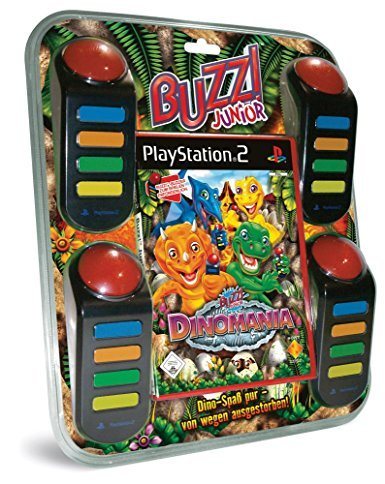
This was fun to write, and right up my alley: a collection of 35 mini-games for kids to play on the PS2. The game shipped with 'Buzz' controllers and offered very simple, colourful gameplay. I wrote seven of the 35 games, created all the games' intro videos, did the sound effects (obviously), and handled the translation into 17 languages.
Buzz! Junior: Dino Den · the PS2 party game in action
The videos were very complex, so I had to write a plugin for the Sony Vegas video suite to help automate the soundtracks for when all the foreign-language dialogue tracks came in. It didn't try to break records on graphics quality, but it was great fun to play and to write, and everybody chipped in designing the games.
During development of the Ice Skating game, I used YMCA as a temp track. You can tell the composer took this to heart; the final music is a complete rip-off. The whole package was finished in an incredibly short time; each mini-game had to be designed and written in two weeks. One of the games I wrote, Elastic Racers, went on to become a stand-alone game.
Buzz! Junior: Dino Den · 35 mini-games on PS2, seven of them mine, plus intro videos, SFX and 17 languages
Six of the seven, in action
Let Sleeping Rex Lie
Swinging Cliff Climb
Cave Painting
Elastic Racers
Surf's Up
Dinos on Ice
Buzz! Junior: Ace Racers
Sony liked the Elastic Racers game from Dino Den, so they asked for a full game based on it, again using the Buzz controllers. As well as the PS2 version, I managed to get it running on a PC by reverse-engineering the Buzz controllers and rewriting the game in Lua. Just an experiment, but it ran really well.
Buzz! Junior: Ace Racers · Elastic Racers grown into a full Buzz game
The Shoot
One of the launch games for Sony's Move controller, basically a shoot-'em-up on rails. As well as all the usual audio work, I wrote a tool that let the designers build all the front-end and UI screens on a PC; it then generated the Lua code and graphics packages that the game consumed.
The Shoot · a PS3 Move launch title, on-rails shooting
Farewell Scotland
I really enjoyed my time at Cohort but, unfortunately, my mother became ill, which made it necessary to move back home to Wales to look after her. Cohort were gracious enough to let me work remotely, and that worked well for quite a while.
After more than a year of flying to Scotland every month, though, it almost came as a relief when Cohort Studios went bust (redundancy number four!). I needed another job, and this one came thanks to Nick Thompson, a former colleague at MicroProse, who was now Studio Manager at Jagex. He offered me a job there as a tools programmer.
Jagex
Senior Tools / Audio Programmer
2010-2013 · Cambridge
C#JavaLua
The Cambridge years
On a cold, snowy, November day I moved to Cambridge, to start work at Jagex. To be honest, I'd never heard of them; I knew they did some sort of online game, but had no clue how widespread and popular it was. Jagex were located in Cambridge Science Park in a building that was far too small for them. I had joined as a tools programmer, and was immediately tasked with updating their audio tools (surprise).
Jagex existed because of the game Runescape, a hugely popular MMORPG. When I joined it had been running for about 12 years and was played by millions of people all over the world. They were constantly adding to it (there was an update every two weeks), which was great for the players; unfortunately it also meant that it was a strange mixture of 12-year-old code, mixed with code that might have been written yesterday. The whole code base seemed to be held together with Blu-Tack and Sellotape. Some of the tools they used to create the game were ancient, written in Java, and were very tired, dated and difficult to use.
The programming room was very intimidating; the holy alliance of engine programmers at one end of the room were very unapproachable (and untouchable too, as only they knew how the game worked). Divas, basically. They ruled the roost and they knew it. However, I plodded on, trying to decipher all this prehistoric code, make the tools easier to use, and improve the game audio (which was of an awful quality). I was pretty miserable really.
The only thing that kept me going is that I got on really well with the guys in the audio department, spending more and more time in their room. I felt at home there. I even started doing voice-overs for the game. Claim to fame: I was the first ever voice actor in Runescape; I played a talking rock!
Then the best possible thing happened. I was given the chance to move in with the audio guys, and support them in the huge task of making the game sound better. A new head of audio, Steve Lord, had joined the company, and had huge ambitions. So, overnight, everything became a lot better. Jagex started getting adventurous, and began making games other than Runescape. What could possibly go wrong?
Runescape
Runescape was first released in 2001, and is the world's largest and most updated MMORPG game. When I joined the company, the audio was of very poor technical quality. All sounds and music had to be downloaded on-the-fly, so the audio was in low bit-rate 8-bit Ogg Vorbis format, nasty! Eventually, we moved over to live orchestral recordings, 16-bit stereo audio, and voice acting. This was a huge undertaking, due to the hours of music that had to be orchestrated, and masses of existing dialog to be recorded, as well as an unimaginable number of sound effects. The work was never-ending, as new quests and adventures were released every few weeks. Still, it paid their bills, and then some.
Runescape · from 8-bit Ogg to live orchestral audio
Transformers Universe
Jagex decided to branch out a bit and create another game. They teamed up with Hasbro (yes, them again) to create an MMORPG based on the Transformers franchise. The game used all-new technology, the artists were allowed to use actual commercial 3D software, and I created the sound system (based on FMOD). Under the hood of the new engine, the game logic was written in Lua.
This was a very exciting project to work on. A lot of new staff were hired, and the company was split into two, Runescape vs Transformers Universe. My old mate Kevin Buckner (Knights of the Sky) was brought in to oversee the project. Somehow, though, the project still lost its way. A public beta was released, but was not greatly received (it had its problems), and Hasbro weren't happy. Very late in the day, a decision was made to switch the game to use the Unity Engine (ironically, something I'd suggested right at the start), and a lot of people lost their jobs. Myself included.
Transformers Universe · the FMOD sound system, game logic in Lua
Carnage Racing
Another foray into something different. I have no idea how this came about, but Jagex acquired Carnage Racing, a game designed to run within Facebook. It was written in the USA, using Unity, and our audio department was tasked with providing the audio. So, it was back to the old Grand Prix times; interminable car engine loops, revband editors, and the Unity audio engine. Such fun. All this was happening at the same time as Transformers Universe, so it was all a bit hectic.
Carnage Racing · back to car engine loops and revband editors
Resting again
Here endeth an enjoyable, if hectic, stint at Jagex. Cambridge had some other software houses dotted around, and London wasn't too far away, but I decided to take a bit of a break. I had a big house in Cambridge, so I took in lodgers. This took the pressure off a bit, and allowed me to take my time deciding what to do next.
I used the time constructively, learning JavaScript, and the joys of web development. However, I also got bored very quickly, and it soon became pretty obvious that I needed to feel useful again, and find a job, I'd had my fill of Cash in the Attic. I was experimenting creating some mobile games when a friend of one of my lodgers saw what I had done, and offered me a job at his company, AllYearBooks.
If You Can
Unity Developer
2014 · London
UnityTools
During one of my "resting" periods, I took a contract at If You Can, an educational-games outfit set up by Trip Hawkins, the founder of Electronic Arts, all very earnest and tree-huggy about the emotional development of children. My job was a tool that ran inside Unity and let designers build storylines visually, as a tree of connected nodes. Between the sheer tedium of it and the 5am starts to commute Cambridge to London, I didn't last long.
iOS games in JavaScript & PhoneGap
Self-taught mobile experiments
2014-2015 · London
JavaScriptPhoneGapCanvas
Another resting period, so I decided to improve myself and find out where the big mobile money supposedly was. I taught myself web game development, JavaScript and Canvas, and used PhoneGap to wrap it into apps for any phone or tablet.
Noticing how many fake-money casino and slot games filled the App Store, I wrote a suite of slots, bingo and poker that ran nicely on every device I could get hold of. They never got finished, because I urgently needed to get a job and pay the rent, but it was good experience, and it led directly to a very enjoyable stint writing casino games at Nektan.
AllYearBooks
Web Application Developer
2015 · Cambridge
JavaScriptNodeCanvas
Through a friend of a friend, I was hired to build a web app for creating professionally printed picture books, a year-round product to sit alongside the company's seasonal school-yearbook business. It used JavaScript and Canvas for the layouts, filters and frames, with a Node.js back end, a bit of NoSQL (MongoDB) fiddling, and some genuinely fancy Canvas effects.
Inevitable funding trouble halted development, and I found myself resting again. The app is lost in the ether somewhere now, but it was rather impressive, if I say so myself.
Nektan
Web Developer
2015-2016 · London
HTML5 CanvasJavaScript
After my short stint at AllYearBooks, I had the JavaScript bug. I'd learned a lot about servers, Canvas, HTML5 and CSS3, so I started looking for web developer jobs, as I was now obviously an expert.
I got a job pretty quickly at Nektan, a company that ran a few online gaming sites: slots, roulette, and so on. They also created promotional games for The Sun newspaper, and various other bits and bobs. They had a very impressive office in a skyscraper in the heart of Victoria, London. I did think it was a little strange that there was just a huddle of people in the middle of this huge office, but I kept that to myself.
Immediately upon joining, I discovered that the other two programmers who worked there were leaving in two weeks. After they left, I would have to maintain all the existing games, finish off the games currently in development, and write new games for their platform.
I didn't feel like such an expert any more.
It transpired that Nektan had bought another failing casino company, and sacked most of their development staff. The very expensive office lease had come with the acquisition. So that cleared up the mystery of the extravagantly empty workspace.
Once the two existing developers had gone, I was faced with a number of challenges:
The server infrastructure had been created by the failed company, and no one really knew how it worked.
The collection of ageing games I had to support were beginning to fail on modern browsers and mobile devices.
My mentors had left the company without telling me how anything worked.
They had left two games unfinished, which were due for release imminently.
One of these games was for The Sun, to support a competition they were running. A real print deadline, and you certainly did not want to get on the wrong side of Rebecca Wade.
After a few weeks of frantic panic, I managed to work most of it out. It turned out to be a massive learning process, and a real baptism of fire.
Once everything had settled down, bugs were fixed, and my blood pressure was back to normal, I had a chance to work on my own games, eventually. First, I had to help bring the game lobby up to scratch. Lots of jQuery and fancy animations involved there.
The bosses wanted all the current full-screen games to work in a frame on the lobby, just so they could display adverts, recommendations, and so on. This was straightforward for the games I had source code for. However, getting third-party games to work in an iframe was fraught with difficulties.
To compound the issue, new rules meant that we had to incorporate a reality check on all games, warning the player if they had been playing for a long time. As most of the games we hosted were written by other developers, in countries that did not have this rule, it was impossible to get everybody to play ball. So all manner of cheating and hacking had to be employed in order for the company to stay legal.
Once all that was done, I finally had a chance to show off the JavaScript Canvas engine I'd been secretly working on. I wrote a quick demo of Cat Hotel using the system, and management decided that all future games would use the engine.
I finished Cat Hotel in a couple of months. Development went very smoothly, and the game was ready for release. While waiting for some server issues to be resolved, I started work on a couple more games, BoogieMan and Dwarven Gold.
After just a few days working on these, it was announced that all UK development would be halted, and moved to India. This was a huge disappointment, but I guessed by now, par for the course.
So... back on the dole. A couple of months later, I had a phone call out of the blue, with a very interesting proposition.
USP Software
Lead Developer
2016-2017 · London
UnrealUnityC#
I got a phone call out of the blue from someone called Adam Caplan, from a company called USP Recruitment, who was interested in developing a game. It was a very confusing conversation, why on earth would a recruitment company want to make games? I arranged to see him the next day at his offices in north London.
He did have a recruitment company, two, in fact, plus a training company and a software company that had built a website for creating employee-training courses. He'd made a maths course for teachers, was about to make a version for children, and thought it would be a good idea to "gamify" it. He wanted something simple that would run on a website, so I went home and knocked up a quick concept. He'd mentioned liking the world screen between levels in the Mario games, so that's what I ran with.
The office was a nightmare to work in. Everyone was crammed into one room: Adam and the sales guy on the phone all day at one end, recruiters on the phone all day at the other, and me stuck in the middle, unable to hear myself think. Still, I came up with a bit more than the initial demo, now an isometric game where you could wander a pseudo-3D world, unlock doors, solve puzzles, and now and again hit an instructional video with accompanying quizzes.
Mathatar
Then Adam had a brainwave: why not make a proper 3D game where the player wanders around solving puzzles and doing maths quizzes, set across all the important time periods (as far as mathematics is concerned)? Over a few weeks this expanded into a sci-fi epic involving time-travelling aliens stealing mathematicians from across the ages, with the player rescuing them by passing maths tests. It would be called Mathatar (I know. Terrible name).
A game like this would normally take a large team of programmers and a whole slew of artists a long time to build. There was just me and Ruben, a 2D artist from Nektan I'd persuaded to join (he did the graphics for BoogieMan). I chose Unity for its device support and C#, a language I knew well.
The minor inconvenience: Ruben had never touched a 3D package. I handed him a demo of Cinema 4D and left him to it. His first attempts were as admirable as they were interesting, one day he presented me with a simple door that had, inexplicably, 100,000 polygons in it. We needed an expert. Luckily I found Simon, a superb modeller who made it his personal mission to teach Ruben 3D. A few months later, Ruben was up there with the best.
I love Unity, but it became obvious it couldn't handle the sheer size of the levels the guys were building, vast cityscapes designed to cope with any eventuality. Adam wouldn't employ a game designer, so we were fumbling in the dark with no clear vision, and what vision he had changed almost daily. Unity's lack of speed in the lighting department, plus constant nagging from Simon, resulted in me reluctantly abandoning it and moving to Unreal Engine 4. Far more capable with large environments, and much better visual quality. Great for the artists; a problem for me, since a lot of my Unity code was now useless.
We persevered. I learned Blueprint (no time for the C++ API) and had something reasonable working again within a month or two. Microsoft got involved, we gained a couple more artists and an actual professional games designer (still just me programming), and the future looked good, we were under the impression Microsoft would fund us and we could grow the team. Unfortunately not. Funding ran out and Mathatar was put on indefinite hold, effectively another redundancy. Such a shame. I'd really enjoyed it, and it could have done very well for all of us.
Mathatar · the Egyptian time zone
Mathatar · the sci-fi maths epic, built in Unreal Engine 4
Mathatar · more of the worlds in motion
SEGA Amusements
Lead Developer
2018-2021 · International
UnityArduinoArcade
My proper dream job. Arcade games were the reason I wanted to make games in the first place, so I was in my element. The studio was built above a vast warehouse filled to the brim with arcade machines, both video and mechanical. I came in as Lead Programmer, built a small team, and we came up with Men In Black.
It was fraught with problems, design changes, gameplay compromises and, biggest of all, Covid. We were furloughed for the best part of a year and weren't allowed to touch the game in that time. In the end I resigned, and I want to be clear it was purely financial: furlough simply didn't pay enough to live on, and with no sign of the work restarting I couldn't afford to stay. It broke my heart to leave a job I loved.
Probably my greatest regret in my career.
Men In Black · lead programmer on the worldwide arcade release, SFX, speech and Arduino cabinet lighting
Electric Square
Senior Programmer
2021-2022 · Remote
UnityFMOD
A well-run studio and a big, polished racing game. I came in remotely to do the audio integration, did it, and moved on when the project wrapped. No drama, which is its own kind of recommendation.
Electric Square · audio integration on a big, polished racing game
Cue Interactive
Head of Programming
2022-2024 · Coventry
UnrealC++Team lead
A university spin-out building serious training sims in Unreal, with genuinely blue-chip clients. Spin-outs are their own adventure, long on ambition, occasionally short on the dull machinery that keeps a company upright.
Doubleslash Studio
Co-founder & Developer
May 2026-present · Cardiff
WebmacOSiOS
The natural next step, and this time with a partner. Doubleslash Studio is a boutique outfit that hand-builds web, macOS and iOS software, custom work for clients who want something crafted rather than churned out. It is the same instinct that has run through the whole career, build it properly and sweat the details nobody else notices. This very website, coded by hand, is one of ours.